
 Email: sales@slxytech.com
 WhatsApp / Wechat:8617062388866
 Phone:+86 17062388866
Description
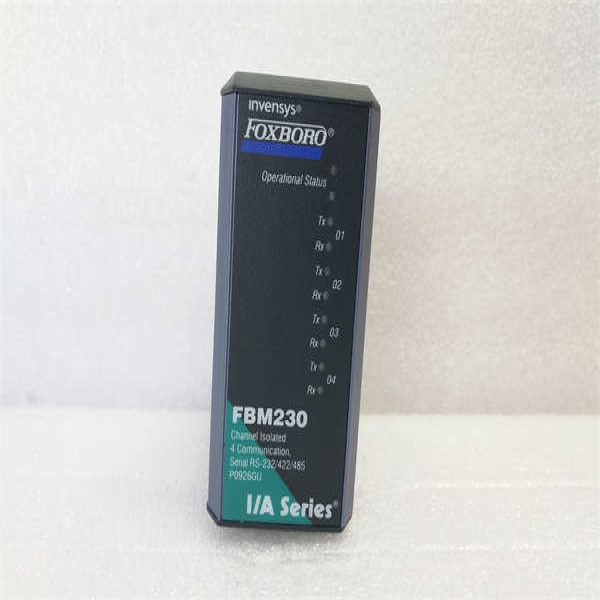
The FOXBORO FBM230 P0926GU is a high-performance Foundation Fieldbus™ H1 Interface Module designed for integration within Foxboro’s industry-leading I/A Series® distributed control systems (DCS). This module serves as a critical communication gateway, enabling bidirectional data exchange between the DCS controllers and intelligent field devices adhering to the FF H1 protocol. The FBM230 P0926GU facilitates real-time process variable monitoring, advanced diagnostics, and precise control command execution across complex automation networks. Engineered for mission-critical applications, it supports up to 16 FF H1 field devices per segment, enhancing system scalability while reducing wiring complexity and installation costs. Its robust design ensures seamless interoperability with a vast ecosystem of Foundation Fieldbus-compatible transmitters, actuators, and positioners, making the FOXBORO FBM230 P0926GU an indispensable component for modern process automation architectures demanding high reliability and open standards compliance.
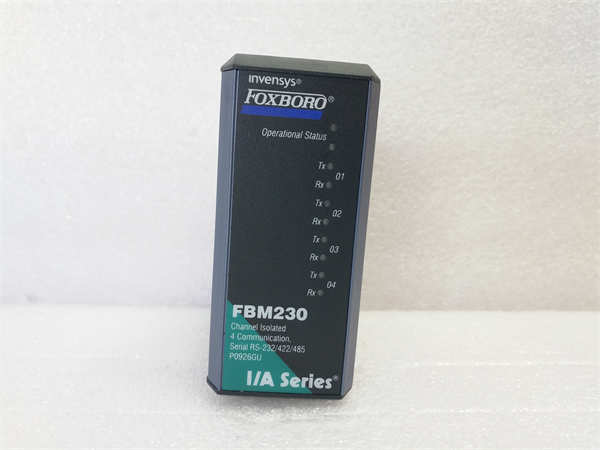
FOXBORO FBM230 P0926GU
Technical Specifications
| Parameter Name | Parameter Value |
| Product Model | FBM230 P0926GU |
| Manufacturer | FOXBORO (a Schneider Electric company) |
| Product Type | Foundation Fieldbus H1 Interface Module |
| Communication Protocol | Foundation Fieldbus H1 (IEC 61158-2 / ISA SP50) |
| Number of Segments | 1 (Redundant pair option available) |
| Devices Supported per Segment | Up to 16 FF H1 devices |
| Power Supply | 24 VDC nominal (18-30 VDC range) |
| Power Consumption | Typically 7W (non-redundant) |
| Operating Temperature | -40°C to +70°C (-40°F to 158°F) |
| Relative Humidity | 5% to 95% non-condensing |
| Certifications | CE, ATEX, IECEx, FM, CSA (Specific certifications depend on exact suffix) |
| Physical Dimensions (HxWxD) | Approx. 150 x 45 x 160 mm (5.9″ x 1.8″ x 6.3″) |
| Mounting | DIN rail or panel mount |
| Redundancy Support | Yes (Requires paired modules & redundancy cable) |
| Diagnostics | Comprehensive segment & device diagnostics via Control Core software |
Main Features and Advantages
The FOXBORO FBM230 P0926GU delivers exceptional value through its advanced engineering:
Deterministic & Reliable Communication: Utilizing the proven Foundation Fieldbus H1 protocol, the module guarantees deterministic control loop execution and reliable data transfer at 31.25 kbit/s, essential for process control integrity. Its robust physical layer design ensures stable communication even in electrically noisy industrial environments.
Enhanced Diagnostics and Asset Management: The module provides extensive diagnostic capabilities, monitoring segment health, device status, and communication errors. This enables predictive maintenance, reduces downtime, and maximizes asset utilization through integration with Foxboro’s Control Core™ asset management tools.
Seamless System Integration: Designed as a native component of the Foxboro I/A Series DCS, the FBM230 P0926GU integrates flawlessly with CP60/CP70 control processors and other FBM fieldbus modules. Configuration and management are streamlined using the intuitive Control Core software suite, significantly reducing engineering effort.
Scalability and Flexibility: Supporting up to 16 devices per segment and offering hardware redundancy options, the module provides significant scalability for expanding plant operations. Its design simplifies adding new field devices without extensive rewiring. The FBM230 P0926GU inherently supports FF’s function block architecture, enabling control strategies to be distributed to field devices, optimizing controller loading.
Application Field
The FOXBORO FBM230 P0926GU is strategically deployed in industries where reliable communication with intelligent field devices and tight process control are paramount:
Process Industries (Oil & Gas, Chemical, Petrochemical): It is extensively used for critical control loops involving FF H1 transmitters (pressure, temperature, flow, level) and valve positioners on distillation columns, reactors, compressors, and pipeline SCADA systems. The FBM230 P0926GU enables advanced control strategies like cascade and split-range control directly within the field network.
Power Generation: In thermal, combined-cycle, and nuclear power plants, the module connects critical FF H1 devices monitoring steam turbines, boilers, feedwater systems, and emissions controls, providing high availability and diagnostic data crucial for plant safety and efficiency.
Pharmaceutical & Fine Chemicals: Its support for precise control and comprehensive diagnostics makes the FBM230 P0926GU ideal for batch processes, clean-in-place (CIP) systems, and utilities management requiring strict adherence to regulatory standards (e.g., FDA 21 CFR Part 11, GAMP) and data integrity.
Water/Wastewater Treatment: The module facilitates efficient control of pumps, blowers, chemical dosing systems, and filter beds using FF H1 devices, optimizing resource usage and process reliability in large-scale treatment facilities.
Related Products
FBM242 P0927GX: Newer generation FF H1 Link Active Scheduler (LAS) module with enhanced performance and diagnostics.
FBM217 P0916YF: Profibus DP-V1 Master Interface Module for integrating Profibus devices into I/A Series.
FBM247 P0917YP: HART® Multiplexer Module for connecting HART field instruments.
CP60 P0916HA: High-performance Control Processor for I/A Series systems, typically connected to FBM modules.
CP70 P0923HA: Next-generation Control Processor offering greater speed and capacity than CP60.
P0916GH FBM201: Analog Input Module for traditional 4-20mA signals.
P0916GM FBM207: Analog Output Module for traditional 4-20mA control signals.
P0916GJ FBM203: Digital Input Module.
P0916GN FBM209: Digital Output Module.
FBM228 P0916GZ: Modbus TCP/IP Interface Module for integrating Modbus devices/systems.
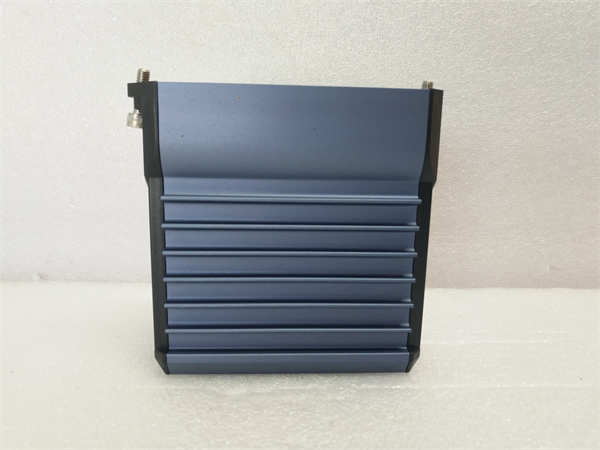
FOXBORO FBM230 P0926GU
Installation and Maintenance
Pre-installation preparation: Ensure the FBM230 P0926GU is compatible with the existing I/A Series hardware and software revision levels. Verify the correct power supply voltage (24VDC) and redundancy requirements. Plan the Foundation Fieldbus segment topology, including terminator placement, segment length (max 1900m), and device count (max 16). Prepare the necessary Control Core software tools and configuration files. Ensure proper grounding practices are followed as per Foxboro installation guidelines to prevent noise issues. Physically inspect the module for any transit damage before mounting.
Maintenance recommendations: Regularly monitor the FBM230 P0926GU status and diagnostic information via the Control Core software or operator workstation. Perform periodic visual inspections for signs of overheating, corrosion, or loose connections. Keep firmware updated to the latest stable version recommended by Foxboro to benefit from bug fixes and performance improvements. Maintain accurate documentation of segment configurations and device parameters. Utilize the module’s built-in diagnostics proactively to identify potential field device or segment communication issues before they cause process disruptions. Ensure spare modules are available and properly configured for critical applications to minimize downtime during replacement.