
 Email: sales@slxytech.com
 WhatsApp / Wechat:8617062388866
 Phone:+86 17062388866
Description
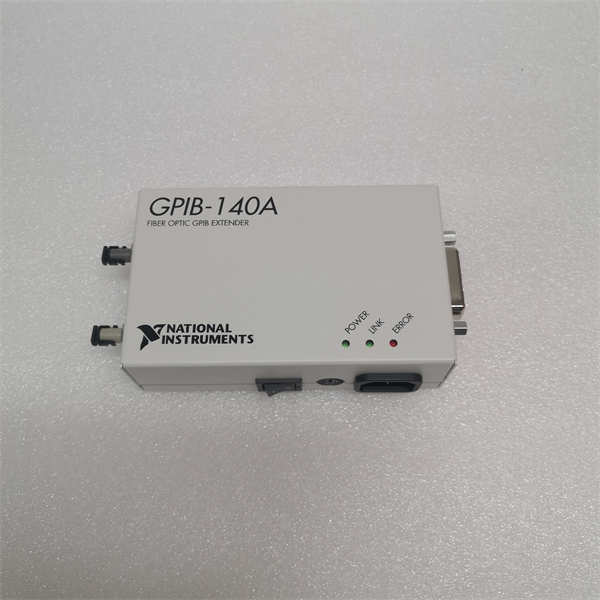
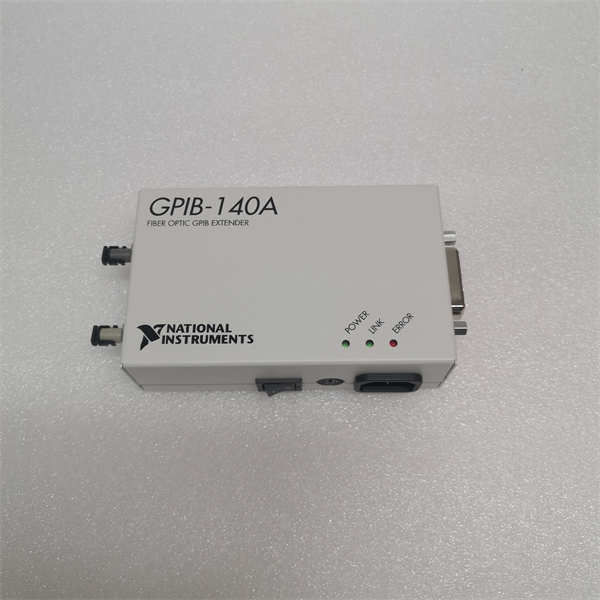
NI(National Instruments)GPIB-140A is a high-performance fiber GPIB(Universal Interface Bus)extender.It aims to break through the limitations of the IEEE 488 standard on GPIB cable length and equipment load,greatly expanding the deployment flexibility of GPIB testing and measurement systems.Traditional GPIB systems typically have a maximum cable length of only 20 meters and can only connect up to 15 devices,posing significant challenges in large testing systems or distributed laboratory environments.NI GPIB-140A converts GPIB signals into high-speed serial fiber optic signals for transmission,effectively extending system cable lengths up to 1 kilometer without sacrificing data integrity or modifying existing software.
GPIB-140A adopts advanced buffer transmission technology,which can achieve a data transmission rate of over 2.8 MB/s under the high-speed HS488 protocol and 1.1 MB/s under the IEEE 488.1 protocol,ensuring the data communication efficiency between remote instruments and controllers.This device is usually used in pairs,with one end connected to a local GPIB controller or instrument and the other end connected to a remote GPIB instrument,and connected through fiber optic cables.As one of NI’s key products in the field of instrument control,GPIB-140A provides a powerful solution for engineers and researchers to build large-scale,remote automated testing and data acquisition systems with its excellent performance and transparent software operation.
GPIB-140A NI
technical specifications
Product model:GPIB-140A
Manufacturer:NI(National Instruments)
Product type:Fiber GPIB extender/bus extender
Compatible standards:IEEE 488.1,IEEE 488.2,HS488
Maximum extension distance:A single pair of GPIB-140A can reach 1 kilometer(using T7 fiber optic cable)
Maximum number of devices:A single extension link can add up to 13 additional devices(the total number of systems can reach 26)
Data transmission rate(IEEE 488.1):up to 1.1 MB/s
Data transfer rate(HS488):exceeding 2.8 MB/s
Data transmission mode:Buffered Mode or Unbuffered Mode
Fiber optic cable type:multimode fiber optic(62.5/125µm),ST connector
Fiber optic wavelength:850 nm(using T7 fiber optic cable)
Electrical isolation:provides electrical isolation between the local bus and the remote bus
Power requirements:100-240 VAC,50/60 Hz(depending on regional version)
Working temperature:0°C to 50°C
Storage temperature:-20°C to 70°C
Software compatibility:Transparent software,no need to modify existing GPIB applications
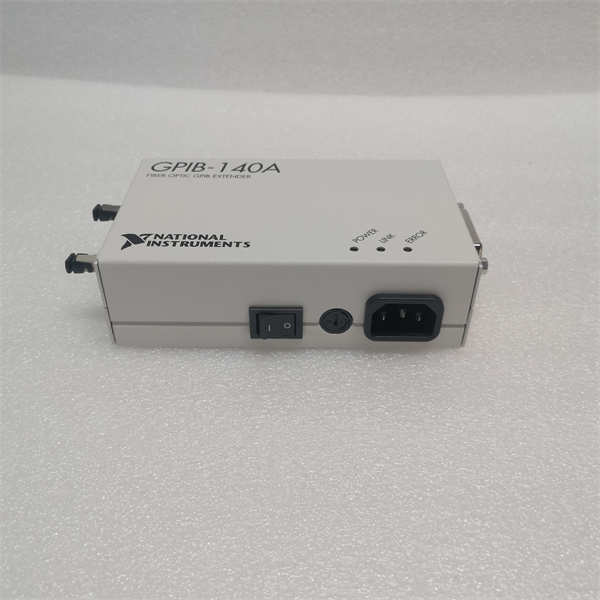
Diagnostic function:Status LED indicator lights(power,link,status)
Main features and advantages
The NI GPIB-140A fiber GPIB extender,with its innovative design and outstanding performance,has brought significant features and advantages to the field of testing and measurement
Breaking through distance and device quantity limitations:The core advantage of GPIB-140A is its ability to easily overcome the limitations of the IEEE 488 standard on GPIB bus cable length(20 meters)and the number of connected devices(15).Through fiber optic connection,a pair of GPIB-140A modules can extend the GPIB system up to 1 kilometer and connect up to 26 GPIB devices.This allows engineers to deploy large or distributed testing systems more flexibly,especially suitable for electromagnetic compatibility(EMC)testing chambers,high-voltage testing environments,or remote sensor networks.
High speed data transmission:Despite extending the distance,NI GPIB-140A still maintains a very high data transmission rate.Under the HS488 protocol of National Instruments,its transmission rate can exceed 2.8 MB/s,while under the standard IEEE 488.1 protocol,it can also reach 1.1 MB/s.This high-speed capability ensures fast data acquisition and instrument control even during remote operations,minimizing testing time and improving testing efficiency.
Fiber optic isolation and anti-interference:GPIB-140A uses fiber optic cables as the transmission medium,which provides complete electrical isolation between the local GPIB bus and the remote GPIB bus.This isolation not only eliminates grounding circuit issues,but also effectively resists electromagnetic interference(EMI),ensuring signal purity and data transmission reliability,especially suitable for industrial or laboratory applications with harsh noise environments.
Software Transparency:The design philosophy of NI GPIB-140A is”software transparency”,which means it does not require any modifications to existing GPIB applications.For users,the expanded GPIB system has the same functionality as the non expanded system,greatly simplifying the system integration and debugging process,and protecting users’initial investment in software development.
Reliable error detection mechanism:To ensure the integrity of data transmission,each GPIB-140A extender has a built-in error detection scheme.It can continuously monitor GPIB activity and perform error checking before converting the signal to fiber optic transmission,and then the receiving end converts the signal back to GPIB format.This mechanism ensures that data remains error free even during long-distance transmission,thereby improving the accuracy of test results and system stability.
GPIB-140A NI
application area
The NI GPIB-140A fiber GPIB extender is widely used in various testing,measurement,and automation fields that require breakthroughs in traditional GPIB distance and equipment limitations.
In EMC(electromagnetic compatibility)testing,GPIB-140A is an ideal choice for connecting test controllers with measuring instruments located in electromagnetic shielding chambers,such as spectrum analyzers,signal generators,etc.The electrical isolation characteristics of optical fibers can effectively prevent interference from external electromagnetic noise,ensure the accuracy of test data,and meet the isolation requirements of electromagnetic shielding rooms.
In large or distributed laboratories,such as university laboratories,research institutions,or product development departments,NI GPIB-140A enables engineers to connect a central control console to remote experimental benches or equipment,enabling remote operation and data collection,improving experimental efficiency and resource utilization.
In high-voltage or hazardous testing environments,such as power equipment testing,high-voltage circuit breaker testing,etc.,the electrical isolation function provided by GPIB-140A is crucial.It can effectively protect control computers and operators from the effects of high voltage or transient voltage,improving the safety of testing.
In the production and quality control process,when automated testing equipment needs to be deployed on longer production lines or in areas far away from control centers,GPIB-140A can ensure high-speed and reliable communication between testing instruments and main controllers,supporting automated testing and data recording on continuous production lines.
In addition,GPIB-140A is also suitable for semiconductor testing,aerospace testing,and any industrial and scientific applications that require expanding the GPIB bus range to accommodate complex or distributed testing system architectures.
Related products
NI GPIB-140A,as a GPIB bus extender,is typically used in conjunction with the following National Instruments products or related components:
NI GPIB Controller:Various NI GPIB interface cards,such as PCI-GPIB,PCIe GPIB,USB-GPIB,etc.,are used as local system controllers to connect with GPIB-140A.
NI LabVIEW software:a graphical programming environment for National Instruments,used for developing and deploying automated testing and measurement applications that interact with GPIB-140A.
NI TestStand software:NI’s test execution management software used to manage and run test instrument sequences connected by GPIB-140A.
NI compatible GPIB instrument:Any testing and measuring instrument that complies with IEEE 488.1 and IEEE 488.2 standards,such as oscilloscopes,multimeters,signal generators,power supplies,etc.
Fiber optic cable:A specific type of multimode fiber optic cable,such as NI’s T7 or T8 series fiber optic cable,used to connect paired GPIB-140A modules.
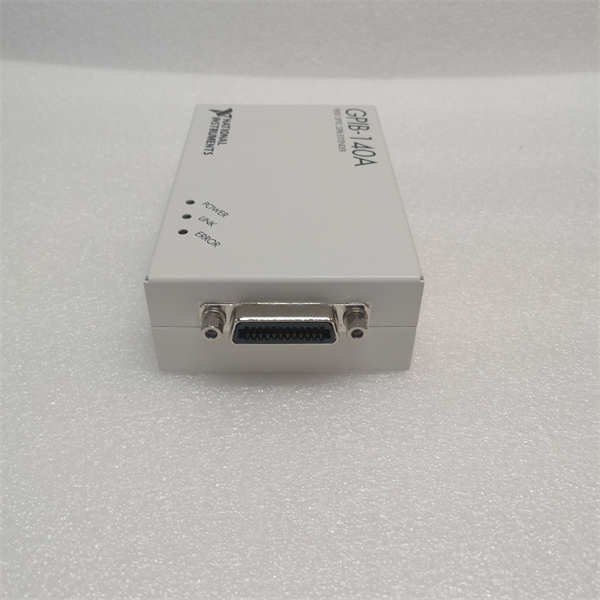
GPIB cable:A standard GPIB cable used to connect GPIB-140A to local/remote GPIB controllers or instruments.
NI MAX(Measurement&Automation Explorer)software:NI’s configuration tool used to discover,configure,and test NI hardware,including GPIB-140A.
NI I/O Libraries:NI provides drivers and libraries that enable GPIB-140A to communicate with various programming languages such as LabVIEW,C,C++,and Python.
Installation and maintenance
Preparation before installation:Before installing the NI GPIB-140A module,please carefully read the official user manual and installation guide provided by National Instruments to ensure a comprehensive understanding of all product functions,safety precautions,and electrical connection requirements.Before performing any physical installation or wiring operations,it is essential to confirm that the main power supply of all related equipment(including computers and GPIB instruments)has been completely disconnected and locked to avoid the risk of electric shock or equipment damage.Check for any physical damage to the GPIB-140A module and its accompanying fiber optic cables.Choose a suitable installation location to ensure that it meets the operating temperature and humidity requirements of the module,and to avoid strong electromagnetic interference sources.Place the GPIB-140A module on a smooth surface or rack.Connect a GPIB-140A module to your GPIB controller(such as NI’s PCI-GPIB or USB-GPIB)or local GPIB instrument using a standard GPIB cable.Then,use another GPIB cable to connect another GPIB-140A module to the remote GPIB instrument.Finally,use appropriate fiber optic cables(such as NI’s T7 or T8 cables)to connect the fiber optic ports of these two GPIB-140A modules,ensuring that the fiber optic connectors are clean and securely inserted.
Maintenance suggestion:To ensure the long-term reliable operation and optimal performance of the NI GPIB-140A module,it is recommended to conduct regular preventive maintenance.Regularly conduct visual inspections of the module to remove any dust or dirt accumulated on the exterior of the device and heat dissipation holes,in order to maintain good heat dissipation.Check if all GPIB cables and fiber optic cables are securely connected without any signs of looseness,corrosion,or physical damage.Especially for fiber optic connectors,they should be kept clean to avoid dust or oil stains affecting the transmission of optical signals;Professional cleaning tools can be used for cleaning when necessary.Observe the POWER,LINK,and STOP LED indicators on the GPIB-140A module,which can provide quick indications of the module’s operational status and link health.If the LED indicator is abnormal,refer to the user manual for fault diagnosis.Due to GPIB-140A being software transparent,its maintenance typically focuses on the hardware level.If encountering performance degradation or communication issues,first check the cable connection,and then use software tools such as NI MAX(Measurement&Automation Explorer)to test and diagnose the GPIB bus.Any advanced maintenance or module replacement should be carried out by professional personnel trained by NI and using original spare parts.
GPIB-140A NI
Product Guarantee
NI(National Instruments)provides comprehensive product assurance for GPIB-140A fiber GPIB extenders,demonstrating its steadfast commitment to product quality and customer satisfaction as a global leader in testing,measurement,and automation.