
 Email: sales@slxytech.com
 WhatsApp / Wechat:8617062388866
 Phone:+86 17062388866
Description
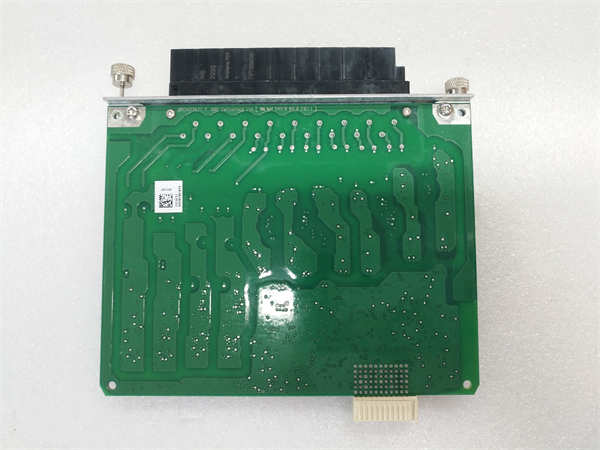
The Delta Tau ACC-5E3 is a versatile analog input/output and encoder feedback expansion card engineered for integration into Delta Tau’s PMAC-based motion control architectures. As a key enabler of closed-loop servo control, the Delta Tau ACC-5E3 provides eight 16-bit analog output channels (±10 V) for driving analog servo amplifiers, along with four high-speed quadrature encoder inputs capable of processing signals up to 20 MHz—supporting A/B/Z or Sin/Cos formats. This makes the Delta Tau ACC-5E3 indispensable in applications requiring sub-micron positioning accuracy, such as semiconductor lithography, precision metrology, and multi-axis CNC machining.
Designed to mount directly onto Delta Tau’s rack-mounted backplanes like the ACC-24E3, the Delta Tau ACC-5E3 leverages the PMAC controller’s deterministic real-time kernel to synchronize I/O updates with trajectory generation at microsecond-level precision. Unlike generic data acquisition cards, the Delta Tau ACC-5E3 is tightly coupled to the PMAC firmware, enabling features like automatic offset calibration, real-time gain adjustment, and hardware-triggered data capture—all programmable via the PMAC Script language or C API. Its robust design includes optical isolation on critical signals and conformal coating options for industrial environments, ensuring long-term reliability in demanding automation settings.
 Technical Specifications
Product Model | ACC-5E3
Manufacturer | Delta Tau Data Systems (OMRON)
Product Type | Analog I/O and Encoder Interface Option Card for PMAC
Compatible Host Platforms | Turbo PMAC2, Power PMAC (with ACC-24E3 or ACC-8E backplane)
Analog Outputs | 8 channels, 16-bit resolution, ±10 V range, 100 kS/s update rate
Analog Inputs | 8 single-ended or 4 differential channels, 16-bit, ±10 V (optional configuration)
Encoder Inputs | 4 channels, quadrature (A/B/Z) or Sin/Cos, up to 20 MHz
Electrical Isolation | Opto-isolated digital I/O; analog grounds configurable
Communication Interface | Proprietary PMAC bus via backplane (no external cabling required)
Update Synchronization | Hardware-timed with PMAC servo interrupt (typically 62.5 µs–1 ms)
Operating Temperature | 0°C to +55°C
Form Factor | Eurocard-style (6U), fits standard ACC-24E3 rack
Main Features and Advantages
High-fidelity analog servo control:
The Delta Tau ACC-5E3 delivers true 16-bit analog outputs with low noise and minimal drift, enabling smooth torque control of legacy analog servo drives that remain prevalent in aerospace test rigs and retrofit machine tools. Each channel supports independent scaling and offset, allowing seamless integration with diverse amplifier models without external signal conditioners.
Advanced encoder feedback flexibility:
Supporting both incremental quadrature and absolute Sin/Cos encoders, the Delta Tau ACC-5E3 accommodates modern high-resolution feedback devices used in direct-drive rotary stages and linear motors. Built-in error detection (e.g., loss of signal, amplitude imbalance) enhances system safety in robotic and medical automation applications.
Tight real-time integration with PMAC:
Unlike third-party I/O cards, the Delta Tau ACC-5E3 operates under the PMAC’s real-time scheduler, ensuring I/O updates occur precisely at the servo loop rate—eliminating jitter that could degrade contouring accuracy in coordinated motion. Users can read/write I/O values directly in the background PLC or motion programs using intuitive M-variable mapping.
Modular scalability and ruggedness:
Multiple Delta Tau ACC-5E3 cards can be installed in a single ACC-24E3 chassis (up to 6 slots), enabling systems with dozens of axes or sensors. The board features ESD protection, reverse-voltage safeguards, and optional conformal coating, making it suitable for factory floors with high EMI or humidity. Its passive cooling design ensures silent, maintenance-free operation.
Application Field
The Delta Tau ACC-5E3 is widely deployed in high-precision motion control systems where analog servo interfaces and high-bandwidth feedback are non-negotiable. In semiconductor equipment manufacturing, it controls wafer alignment stages and reticle scanners that demand nanometer-level repeatability—leveraging its low-noise analog outputs and high-speed encoder inputs to maintain closed-loop stability during rapid acceleration profiles. Similarly, in advanced CNC machines for turbine blade machining, the Delta Tau ACC-5E3 synchronizes multiple analog-driven spindles and linear axes to achieve complex 5-axis contours with minimal tracking error.
Research and test automation also benefit significantly: wind tunnel actuator arrays, flight simulator motion bases, and material fatigue testers often rely on the Delta Tau ACC-5E3 to interface with legacy analog hydraulic or torque motor systems while capturing real-time position data from high-resolution encoders. In medical robotics—such as surgical navigation platforms—the Delta Tau ACC-5E3’s deterministic timing and signal integrity ensure patient-safe operation under strict regulatory requirements. Even in modern retrofits, where digital drives are preferred, the Delta Tau ACC-5E3 serves as a cost-effective bridge to extend the life of proven analog infrastructure without compromising performance.
 Related Products
ACC-24E3: 6-slot Eurocard backplane chassis—primary host for ACC-5E3 in Turbo PMAC2 systems.
ACC-8E: Compact 2-slot rack for Power PMAC—supports ACC-5E3 with reduced channel count per system.
ACC-28B: Digital I/O companion card—often paired with ACC-5E3 for limit switches and enable signals.
Turbo PMAC2 CPU: Main controller board that orchestrates ACC-5E3 I/O via shared memory and interrupts.
ACC-5E: Predecessor model—lower encoder bandwidth; ACC-5E3 is backward-compatible in most firmware versions.
Power PMAC: Next-generation controller—fully supports ACC-5E3 via ACC-8E or ACC-24E3 adapters.
ACC-14E: Analog input-only variant—used when only sensor feedback (not drive output) is needed.
Installation and Maintenance
Pre-installation preparation: Before installing the Delta Tau ACC-5E3, power down the PMAC system and discharge static electricity using a grounded wrist strap. Confirm compatibility with your backplane (ACC-24E3 or ACC-8E) and PMAC firmware version—older releases may require updates for full ACC-5E3 functionality. Align the card carefully with the guide rails and press firmly until fully seated in the connector; incomplete insertion can cause intermittent communication or I/O errors. Secure with the provided retention screw to prevent vibration-induced loosening.
Maintenance recommendations: The Delta Tau ACC-5E3 contains no user-serviceable components. If analog outputs drift or encoder counts become erratic, first verify grounding integrity and shielded cabling per Delta Tau’s installation guidelines. Use PMAC’s built-in diagnostics (e.g., Ixx and Mxx variables) to monitor I/O health without external meters. Store spare Delta Tau ACC-5E3 units in anti-static packaging within dry, temperature-controlled environments. Avoid repeated hot-plugging, as thermal stress can fatigue the edge connector over time. Log firmware and hardware revisions during replacement to maintain system traceability.