
 Email: sales@slxytech.com
 WhatsApp / Wechat:8617062388866
 Phone:+86 17062388866
Description
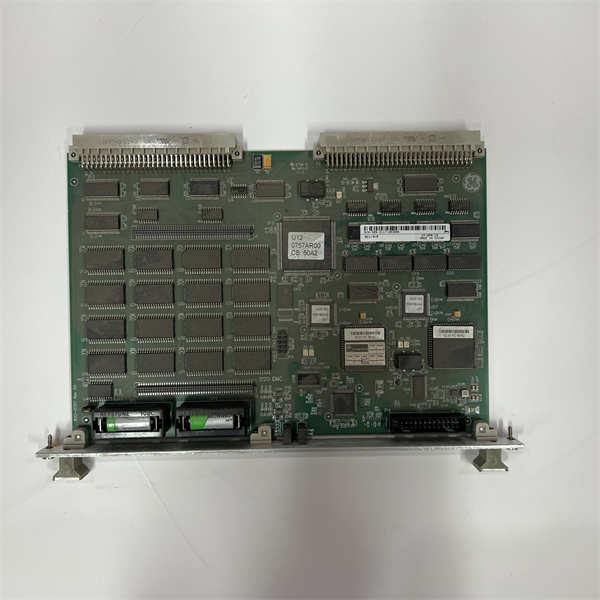
The GE D20 EME module serves as a crucial upgrade or foundational component for GE’s D20 and D200 substation automation platforms. Its primary functions are to provide Ethernet connectivity and expand the system’s memory capacity, thereby enhancing the overall processing and communication capabilities of the RTU or substation controller. The date “27-APR-13” likely indicates a specific firmware version, hardware revision, or manufacturing batch date, which can be important for compatibility, troubleshooting, and software updates.
Application Scenarios:
Imagine a large utility company managing a vast network of electrical substations across a wide geographical area. For years, these substations relied on older communication methods, leading to slower data updates and limited remote control capabilities. As the grid became more complex with renewable energy integration and smart grid initiatives, the need for faster, more reliable communication became critical. The utility decided to upgrade its D20 and D200 series RTUs.
By installing the GE D20 EME (27-APR-13) modules, the utility significantly enhanced its communication infrastructure. These modules provided the necessary Ethernet ports, allowing the RTUs to connect to the modern substation local area networks (LANs). This facilitated high-speed data exchange with Intelligent Electronic Devices (IEDs) like protection relays and circuit breaker controls. The expanded memory on the EME module also enabled the RTUs to handle more complex automation logic and store larger volumes of event logs and historical data. This resulted in:
Faster Fault Isolation:Real-time data from IEDs allowed control center operators to quickly identify and isolate faults, reducing outage durations for customers.
Improved Operational Efficiency:Enhanced communication supported more advanced SCADA functions, enabling precise remote control of substation equipment and optimized power flow.
Scalability for Future Needs:The expanded memory and Ethernet capabilities provided a robust platform for integrating new smart grid technologies and managing increasing data volumes without requiring a complete system overhaul.
The GE D20 EME (27-APR-13) module became instrumental in modernizing the utility’s grid operations, improving reliability and responsiveness.
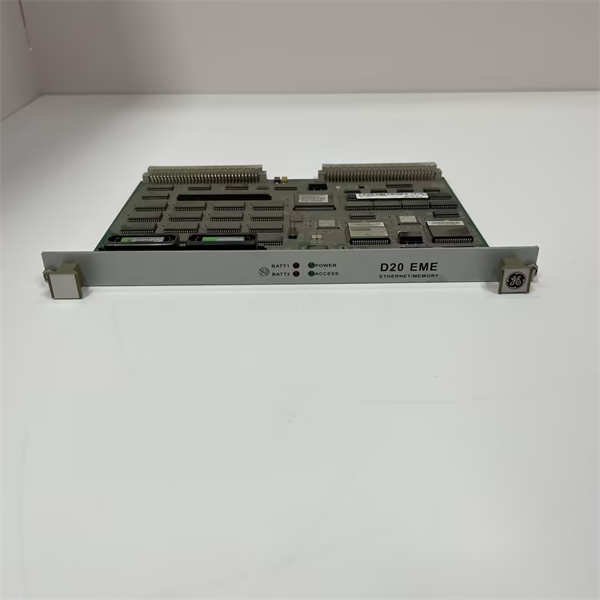
GE D20 EME 27-APR-13
Parameter:
Here are the key parameters for the GE D20 EME (27-APR-13) module, based on general D20 EME specifications and common module features:
| Main Parameters Value/Description |
| Product Model: D20 EME |
| Manufacturer: General Electric (GE) / GE Grid Solutions |
| Product Category: Ethernet/Memory Expansion Board / Substation Controller Module |
| Revision/Date Code: 27-APR-13 |
| System Compatibility: GE D20 and D200 Series Chassis |
| Functionality: Ethernet Connectivity and Memory Expansion |
| Ethernet Media Types: Supports 10BASE-T, 10BASE-2 (coaxial), 10BASE-FL (fiber optic) |
| Memory Options: Available with 0 MB, 8 MB, or 16 MB battery-backed SRAM |
| Communication Ports: Typically includes serial ports (e.g., RS-232/485) and D.20 Link HDLC ports in addition to Ethernet |
| Installation: Plugs into a specific slot in the D20/D200 chassis |
| Redundancy Support: The D20/D200 system with D20 EME can support redundancy mechanisms |
| Environmental Standards: Designed for demanding substation environments, compliant with industrial EMC standards (e.g., EN 61000-6-2, EN 61000-6-4) |
| Power Supply: Operates within the D20/D200 system power supply range |
GE D20 EME 27-APR-13
Technical Principles and Innovative Values:
The GE D20 EME (27-APR-13) module is designed with key technical principles to deliver robust performance in substation automation.
Innovation Point 1: Integrated Ethernet and Memory Expansion: The D20 EMEoffers a dual benefit by combining Ethernet communication with significant memory expansion on a single board. This integrated approach optimizes the D20 system’s footprint and simplifies wiring compared to needing separate modules for these functions. The expanded memory (up to 16 MB battery-backed SRAM) is crucial for handling complex substation automation applications, storing extensive event logs, waveforms, and configuration data, which is vital for post-event analysis and optimizing grid operations.
Innovation Point 2: Versatile Ethernet Media Support: The ability to support multiple Ethernet media types (10BASE-T, 10BASE-2, 10BASE-FL) through various Media Interface Cards (MICs) makes the D20 EMEhighly adaptable. This flexibility allows utilities to leverage existing cabling infrastructure or deploy the most suitable medium for new installations (e.g., fiber for long distances and immunity to electromagnetic interference). This reduces infrastructure costs and provides robust communication in diverse substation environments.
Innovation Point 3: Hardened Design for Critical Infrastructure: The D20 EMEis not a standard commercial Ethernet card; it’s an industrial-grade module built to withstand the extreme conditions of substations. This includes compliance with stringent environmental standards for immunity to electromagnetic interference (EMI), temperature fluctuations, and vibrations. Its robust design ensures reliable and continuous operation in challenging electrical environments, which is paramount for maintaining grid stability and preventing costly outages.
Related Product Combination Solutions:
The GE D20 EME (27-APR-13) is an essential component within the broader GE D20/D200 substation automation and RTU system. It’s typically combined with:
GE D20MX or D200 Chassis: The main enclosure that houses the D20 EMEand other D20 modules.
GE D20ME II CPU Board: The central processing unit of the D20 system, which communicates with the D20 EME to send and receive data over the network and manage the expanded memory.
GE D20 I/O Modules: Various digital input (D20S), digital output (D20K), analog input (D20A), and analog output (D20C) modules that interface with substation equipment, with their data being handled by the D20 CPU and communicated via the D20 EME.
GE Multilin Protection Relays / IEDs: Intelligent Electronic Devices such as GE’s F60, G60, D400, or other third-party relays, which communicate with the D20 controller (and thus via the D20 EME) to provide critical protection and control data.
SCADA Master Station / DMS (Distribution Management System): The central control system that receives data and sends commands through the network link enabled by the D20 EME, often utilizing protocols like DNP3, IEC 61850, or Modbus.
Media Interface Cards (MICs): Specific transceivers that plug into the D20 EMEto adapt to the desired Ethernet physical layer (e.g., 10BASE-T, 10BASE-2, 10BASE-FL).
Installation, Maintenance, and Full-Cycle Support:
The GE D20 EME (27-APR-13) module is designed for relatively straightforward installation within its intended D20/D200 chassis. It slides into a dedicated slot, and its connection to the system’s internal backplane provides power and communication paths. Installation often requires selecting and inserting the appropriate Media Interface Card (MIC) to match the desired Ethernet cabling. GE provides detailed technical manuals (e.g., for the D20/D200 system) that outline installation procedures, cabling requirements, and any specific configuration steps, including potential jumper settings, to ensure proper operation. Its robust construction ensures reliable performance in the demanding electrical and environmental conditions typical of substations.
Routine maintenance for the D20 EME (27-APR-13) primarily involves ensuring the physical integrity of the module and its connections within the chassis, and verifying the stability of the operating environment (temperature, humidity, cleanliness). Given its solid-state design, there are no moving parts or components requiring regular mechanical maintenance. Diagnostics are typically performed through the D20 system’s software tools, which can monitor communication status and module health. In the rare event of a failure, the modular design facilitates quick replacement, minimizing downtime for critical substation operations.
GE (now often under GE Grid Solutions or GE Vernova) provides comprehensive full-cycle support for its D20 platform, including the D20 EME modules. This support typically includes access to technical documentation, software updates, and a global network of field service engineers specializing in substation automation. While products with specific date codes like “27-APR-13” might signify a mature product generation, GE usually offers repair services, spare parts availability, and technical assistance to ensure the continued operational effectiveness and longevity of these crucial components within your grid infrastructure.