
 Email: sales@slxytech.com
 WhatsApp / Wechat:8617062388866
 Phone:+86 17062388866
Description
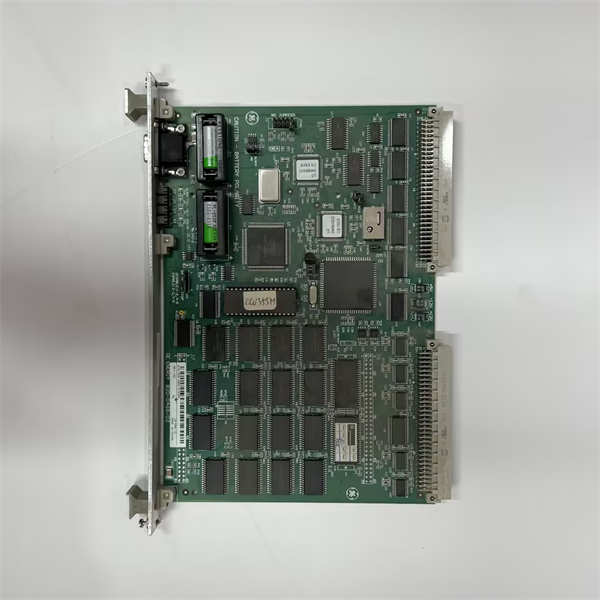
The GE WESDAC D20ME is the central processing unit (CPU) board for the D20 and D200 series of Substation Controllers. It acts as the “brain” of the RTU, responsible for:
Data Collection & Processing:Acquiring data from various Intelligent Electronic Devices (IEDs) in the substation (e.g., protection relays, meters, circuit breakers).
Protocol Conversion:Translating data between different communication protocols (e.g., DNP3, IEC 61850, Modbus) to ensure interoperability between devices and the SCADA master station.
Local Automation & Logic Execution:Running user-defined logic (often IEC 61131-3 compliant, like LogicLinx™) to implement substation automation schemes (e.g., automatic voltage control, feeder automation, load transfer).
Communication Gateway:Providing communication interfaces to transmit processed data upstream to master stations (SCADA, EMS, DMS) and receive control commands.
Memory Management:Storing configuration data, application programs, event logs (SOE), and historical data.
The “18-MAR-13” suffix denotes a specific version or production batch, which can be relevant for software compatibility, firmware updates, or detailed technical support inquiries.
Application Scenarios:
Consider a critical high-voltage transmission substation responsible for distributing power to a major city. An aging RTU struggles with the increasing volume of data from modern digital relays and the need for more complex local automation to improve grid resilience. Manual operations are time-consuming and prone to human error during grid disturbances.
By upgrading to or installing a GE WESDAC D20ME (18-MAR-13) as the central controller, the utility could achieve significant improvements:
Advanced Substation Automation:The D20ME’s processing power enables sophisticated local automation applications. For instance, it can run a comprehensive Automatic Voltage Control (AVC) module to maintain steady voltage levels, or implement fault localization and automatic restoration schemes to quickly isolate faults and restore power to unaffected areas.
Enhanced Data Concentration:It efficiently collects and consolidates data from a multitude of IEDs, acting as a data concentrator that then reports summarized and critical information to the central control center, reducing network traffic and improving situational awareness for operators.
Seamless Interoperability:With support for a wide range of communication protocols (e.g., IEC 61850, DNP3), the D20ME allows the substation to integrate diverse legacy and modern devices, creating a unified control and monitoring platform. This reduces the need for multiple, specialized gateways and simplifies system architecture.
The WESDAC D20ME (18-MAR-13) enables the substation to operate more autonomously and intelligently, leading to increased grid reliability, reduced operational costs (due to faster fault recovery and optimized resource utilization), and improved overall power quality.
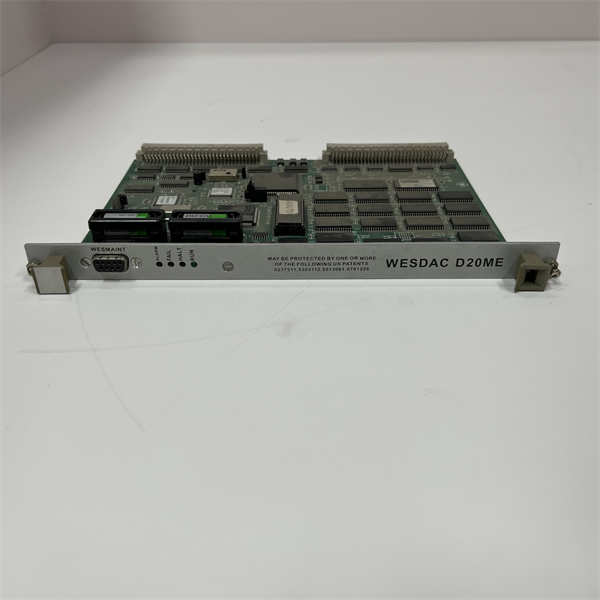
GE WESDAC D20ME 18-MAR-13
Parameter:
Here are the key parameters for the GE WESDAC D20ME (18-MAR-13) Substation Controller Processor Module:
| Main Parameters Value/Description |
| Product Model: WESDAC D20ME |
| Manufacturer: General Electric (GE) / GE Grid Solutions (now GE Vernova) |
| Product Category: Substation Controller Processor Module / RTU CPU |
| Revision/Date Code: 18-MAR-13 |
| Processor: 32-bit microprocessor architecture |
| Memory: 2 MB Flash application memory, 1.5 MB SRAM, 512 KB NVRAM, 1 MB BootROM |
| Communication Ports: |
| 7 x RS-232/485 serial ports |
| 1 x RS-232 maintenance port |
| 2 x D.20 Link HDLC ports |
| Wireless Ethernet Ready with PPP/TCP/IP (requires D20EME module for physical Ethernet) |
| Clock Accuracy: TCXO clock, 1.0 ms resolution, accurate to ±2 ppm |
| Logic Execution: Supports IEC 61131-3 compliant PLC-type logic (LogicLinx™) |
| Self-Diagnostics: Program memory checksums, RAM tests, configuration verification, watchdog, power monitor, I/O module health checks, error logger |
| Power Supply Options: 20-60 VDC, 100-300 VDC / 85-264 VAC |
| Operating Temperature: 0°C to +55°C (32°F to +131°F) |
| Storage Temperature: -40°C to +70°C (-40°F to +158°F) |
| Humidity: 5% to 95% (non-condensing) |
| Mounting: 19″ rack mount (for D20/D200 chassis) |
| Vibration/Shock: Designed to meet industry standards for vibration (5-2000Hz, 5g peak) and shock (10g, 11ms half-sine) |
Technical Principles and Innovative Values:
The GE WESDAC D20ME module incorporates advanced technical principles to deliver high performance and reliability in substation automation:
Innovation Point 1: Distributed Processing Architecture and Scalable I/O: The D20ME operates within a distributed processing architecture where it can interface with numerous distributed I/O modules (D20S, D20A, D20K, D20C) via D.20 Link HDLC ports. This allows I/O to be located closer to the primary equipment, minimizing wiring and maximizing efficiency. The D20/D200 platform is highly scalable, supporting configurations from a few hundred points to over 75,000 SCADA points, with multiple CPU boards (up to 7 in D200 chassis), providing immense flexibility for various substation sizes and complexities.
Innovation Point 2: Comprehensive Protocol Support and Interoperability: A critical innovation of the D20ME is its extensive support for a wide range of SCADA host protocols (e.g., DNP3, Modbus, IEC 60870-5-101/104) and IED protocols (e.g., IEC 61850). This enables the D20ME to act as a powerful protocol converter and data concentrator, facilitating seamless interoperability between diverse devices and systems from multiple vendors. This “agnostic” approach significantly simplifies system integration and future upgrades in complex utility environments.
Innovation Point 3: Mission-Critical Automation and Reliability Features: The D20ME is engineered for mission-critical applications. It features a high-performance 32-bit microprocessor for executing complex local automation algorithms, reducing reliance on the central SCADA for fast control loops. Integrated self-diagnostics (e.g., RAM tests, watchdog, I/O module health checks) provide continuous monitoring of system health. Furthermore, the D20/D200 platform supports redundancy options for CPUs and communication links, ensuring high availability and continuous operation even in the event of component failures, which is vital for grid stability.
Application Cases and Industry Value:
A major electric utility was modernizing an older switchyard with new digital protection relays (IEC 61850 compliant) but still had legacy RTUs and a SCADA system that only supported DNP3. Implementing a new, expensive SCADA system was not immediately feasible.
The utility chose to install GE D20MX controllers with the WESDAC D20ME (18-MAR-13) modules in these substations. The D20ME’s robust protocol conversion capabilities allowed it to act as a bridge:
It communicated directly with the new IEC 61850 relays, collecting real-time data and event reports.
It then translated this data into DNP3 messages, which were seamlessly forwarded to the existing SCADA master station.
This solution avoided a costly full SCADA replacement while still leveraging the benefits of new, advanced IEDs. The D20ME’s local automation capabilities also enabled the utility to implement new automatic reclosing schemes for feeders, significantly reducing customer outage times following momentary faults. The value derived included:
Cost Savings: Deferred SCADA system replacement and avoided complex custom integration solutions.
Improved Grid Reliability: Faster fault detection and isolation, leading to reduced customer interruptions.
Enhanced Operational Visibility: Seamless integration of new IED data into the existing SCADA system.
Future-Proofing: Established a platform ready for full IEC 61850 implementation in the future.
Related Product Combination Solutions:
The GE WESDAC D20ME (18-MAR-13) is the central component of a larger system. It is typically combined with:
GE D20MX or D200 Chassis: The physical housing for the D20ME and other modules.
GE D20 I/O Modules: These include:
D20S(Status Input Module)
D20A(Analog Input Module)
D20K(Control Output Module, for digital outputs like breaker trip/close)
D20C(Analog Output Module) These modules acquire field data which is then processed by the D20ME.
GE D20EME Ethernet/Memory Expansion Board: While the D20ME has serial ports, the D20EME adds physical Ethernet ports (10BASE-T, fiber optic options) and further memory expansion for enhanced network communication.
GE Multilin Protection Relays / IEDs: Devices like the F60, G60, L90, D60, and others that communicate their protection, control, and measurement data to the D20ME.
GE Modems: For serial communication over leased lines or dial-up, the D20 chassis supports specific modem modules.
SCADA Master Station / DMS (Distribution Management System) / EMS (Energy Management System): The higher-level control systems that interact with the D20ME for monitoring and control.
GE MDS Wireless Radios: For remote substation communication where wired infrastructure is not feasible.
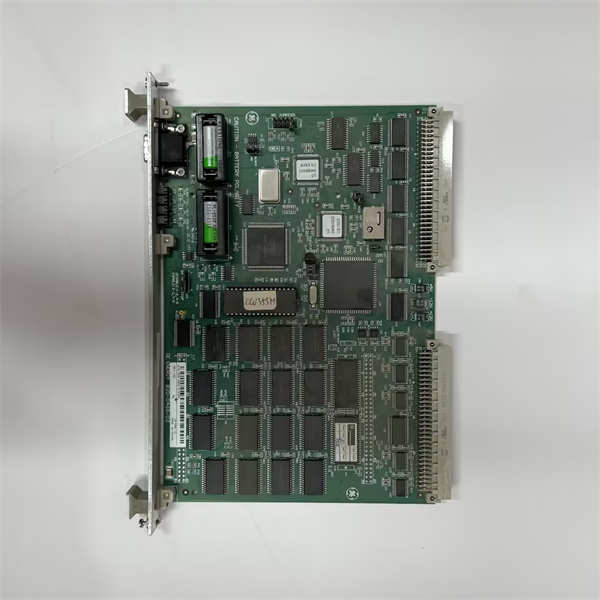
GE WESDAC D20ME 18-MAR-13
Installation, Maintenance, and Full-Cycle Support:
The GE WESDAC D20ME (18-MAR-13) is designed for straightforward installation within the D20/D200 series chassis. It slides into a dedicated slot and connects to the backplane, which provides power and internal communication. Initial configuration and programming are performed using GE’s specialized software tools (e.g., ConfigPro, LogicLinx, SGConfig), which allow engineers to define I/O mapping, protocol settings, and automation logic. Its industrial-grade construction ensures reliable operation across the specified temperature, humidity, and vibration ranges common in substations.
Routine maintenance for the D20ME is minimal due to its solid-state electronic design. It typically involves periodic checks of system diagnostics via the software tools, verifying communication status, and ensuring proper environmental conditions within the control cabinet. The comprehensive self-diagnostics built into the module and the D20 system provide alerts for any operational anomalies, facilitating proactive troubleshooting. In the event of a fault, the modular design of the D20 system allows for relatively quick replacement of the D20ME module, minimizing disruption to critical substation operations.