
 Email: sales@slxytech.com
 WhatsApp / Wechat:8617062388866
 Phone:+86 17062388866
Description
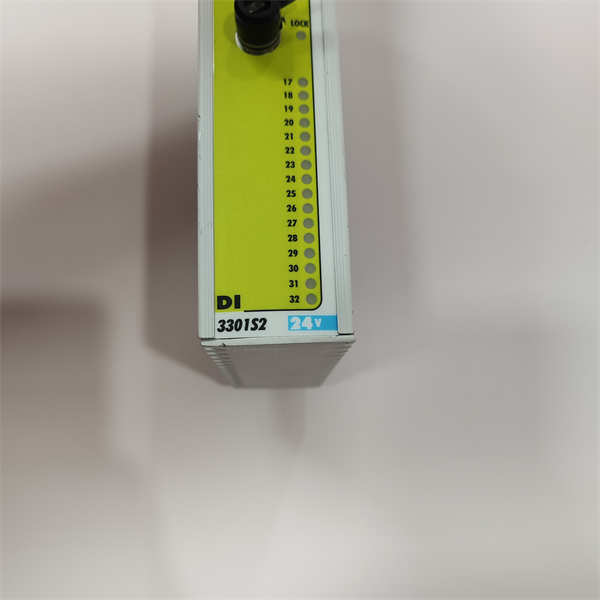
The TRICONEX DI3301S2 is a vital 32-channel Digital Input Module from Triconex, a global leader in high-integrity safety and critical control solutions, now part of Schneider Electric. Designed for seamless integration into Triconex Safety Instrumented Systems (SIS), this module reliably acquires digital signals from field devices, serving as the foundational layer for emergency shutdown (ESD), fire and gas (F&G), burner management (BMS), and other safety-critical applications.
Application Scenarios:
Consider a massive offshore oil and gas production platform, where an accidental overpressure in a separator vessel could lead to a catastrophic explosion, endangering personnel and causing immense environmental damage. The platform’s safety relies on an Emergency Shutdown (ESD) system, which must react instantly and flawlessly to abnormal conditions. Here, numerous pressure switches, level switches, and manual push-buttons are strategically placed across the facility to detect hazardous states. Each of these field devices sends a simple “on” or “off” signal. The TRICONEX DI3301S2 modules are at the heart of this system, receiving these critical digital inputs. For example, if a pressure switch detects an unsafe pressure excursion, it sends a trip signal to the TRICONEX DI3301S2. Thanks to the inherent Triple Modular Redundant (TMR) architecture of the Triconex system, even if one input channel or associated component on a TRICONEX DI3301S2 fails, the fault is masked, and the correct, safe signal is passed to the safety controller. This ensures that the ESD system activates without fail, initiating a safe shutdown sequence that prevents the escalating hazard and protects lives and assets, directly addressing the pain point of unreliable safety responses.
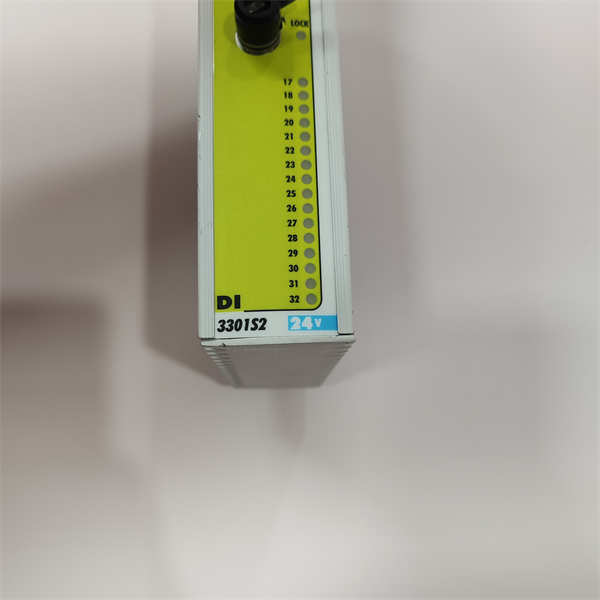
TRICONEX DI3301S2
Parameter:
| Main Parameters Value/Description |
| Product Model: DI3301S2 |
| Manufacturer: Triconex (Schneider Electric) |
| Product Category: Digital Input Module |
| Channels: 32 Digital Input Channels |
| Nominal Input Voltage: 24 VDC |
| Operational Voltage Range: 15–30 VDC |
| Absolute Maximum Input Voltage: 33 VDC |
| Input Current: 6 mA (typical @ 24 VDC) |
| Input Impedance: >30 k$\Omega$ (without baseplate), $\approx$3 k$\Omega$ (with baseplate) |
| Input Signal Delay: <10> |
| Safety Compliance: Meets IEC 61508 SIL 3 |
| Redundancy Support: Supports Triple Modular Redundancy (TMR) |
| Diagnostics: Built-in fault detection, isolation, and fault tolerance |
| Operating Temperature Range: -40°C to +70°C (-40°F to +158°F) |
| Installation Method: Rack-mounted |
Technical Principles and Innovative Values:
The TRICONEX DI3301S2 is engineered with advanced technical principles that underpin its exceptional reliability and safety performance, delivering significant innovative value:
- Innovation Point 1: Triple Modular Redundancy (TMR) for Unparalleled Fault Tolerance: The cornerstone of the Triconex system, and inherent to the TRICONEX DI3301S2, is its Triple Modular Redundant (TMR) architecture. Unlike conventional systems, the DI3301S2(when part of a TMR configuration) functions within three physically and electrically isolated channels (“legs”). Each leg independently processes inputs, and a sophisticated 2-out-of-3 voting mechanism ensures that a single fault in any channel (e.g., a sensor failure, a module component failure, or a wiring issue) is automatically detected, identified, and masked without interrupting the process or compromising the safety function. This ensures continuous, error-free operation even during failures, providing an order of magnitude higher availability and integrity compared to non-TMR systems.
- Innovation Point 2: Comprehensive Diagnostics and Online Module Replacement: The TRICONEX DI3301S2features extensive built-in diagnostics at the module and channel level. These diagnostics continuously monitor the health of the input circuits, detecting open circuits, short circuits, and other anomalies. If a fault is detected, the module can isolate the faulty component, allowing the remaining healthy channels to maintain control. Furthermore, faulty DI3301S2 modules can be replaced online (“hot-swappable”) without interrupting the safety function or requiring a process shutdown. This significantly reduces maintenance time, minimizes human error during repairs, and dramatically enhances plant uptime while maintaining the highest safety integrity.
- Innovation Point 3: Rigorous IEC 61508 SIL 3 Certification for Critical Safety: The TRICONEX DI3301S2, as part of the Triconex system, is certified to IEC 61508 Safety Integrity Level 3 (SIL 3). This rigorous certification signifies that the module and system design have been independently verified to achieve extremely low probabilities of dangerous failure, making it suitable for applications where safety failure could result in severe consequences (e.g., loss of life, significant environmental damage, or massive financial loss). This level of certification provides an independent, quantitative assurance of safety performance that differentiates Triconex from many standard industrial control systems.
Application Cases and Industry Value:
In a large chemical processing facility, the Burner Management System (BMS) for its industrial furnaces was critical for both process efficiency and preventing explosive conditions. An unreliable flame detection or fuel valve position feedback could lead to uncontrolled fuel release or flameouts, risking severe incidents. The facility’s aging BMS was prone to nuisance trips and lacked robust diagnostics.
The plant upgraded its BMS with a Triconex system, integrating several TRICONEX DI3301S2 modules to monitor hundreds of discrete inputs from flame detectors, fuel valve limit switches, and purge air flow switches.
The impact was immediate and profound. The TMR architecture of the TRICONEX DI3301S2 virtually eliminated nuisance trips previously caused by faulty individual sensors or noisy signals, leading to a 10% increase in burner uptime and corresponding production gains. The rigorous SIL 3 certification provided the plant with unprecedented confidence in its safety system’s ability to respond to actual hazardous conditions, significantly reducing the risk of uncontrolled combustion incidents. Furthermore, the detailed diagnostics reported by the DI3301S2 allowed maintenance personnel to proactively identify failing sensors before they could trigger a false alarm or compromise safety, streamlining maintenance efforts and ensuring the continuous, safe, and efficient operation of the furnaces.
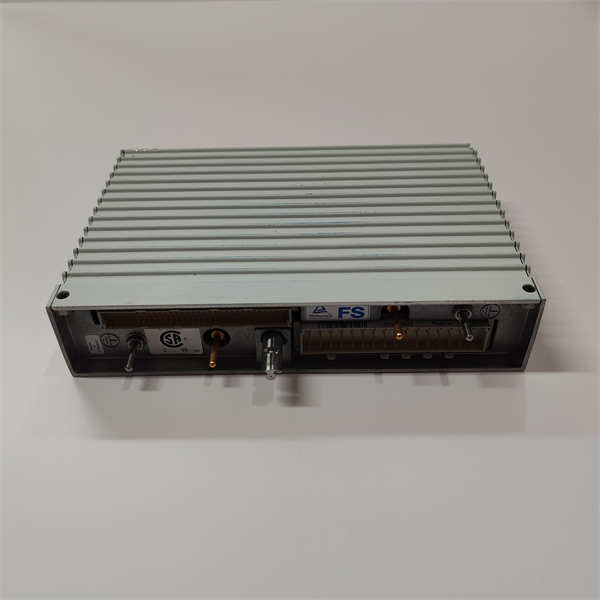
TRICONEX DI3301S2
Related Product Combination Solutions:
The TRICONEX DI3301S2 is a core component within the Triconex Safety Instrumented System, typically operating in conjunction with:
- Triconex Main Processor Modules (e.g., MP3008, MP3007): These are the central processing units of the Triconex system, executing the safety logic based on inputs from modules like the DI3301S2.
- Triconex Communication Modules (e.g., TCM 4351B, NCM): Provide connectivity for programming, diagnostics, and data exchange with external systems like DCS/SCADA.
- Triconex Digital Output Modules (e.g., DO3381, DO3382): Receive commands from the processor to actuate final elements like shutdown valves or motor trip relays.
- Triconex Analog Input Modules (e.g., AI3351, AI3351S): Monitor continuous process variables like pressure and temperature, often alongside digital inputs for comprehensive safety.
- Triconex Chassis/Rack (e.g., 8110): The physical enclosure that houses the modules and provides power and communication pathways.
- Triconex Power Supplies (e.g., PS8310, PS8312): Provide redundant power to the entire Triconex system.
- TriStation 1131 Software: The engineering workstation software used to configure, program, and diagnose the Triconex system, including the DI3301S2
- External Termination Assemblies (ETAs): Field wiring connects to these terminal blocks, which then connect to the DI3301S2I/O module via prefabricated cables.
Installation, Maintenance, and Full-Cycle Support:
Installation of the TRICONEX DI3301S2 module involves hot-insertion into a vacant slot within the Triconex chassis (rack). Its modular design allows for straightforward physical placement. Field wiring from the digital sensors (e.g., limit switches, pressure switches) connects to the corresponding points on an External Termination Assembly (ETA), which then interfaces with the DI3301S2 via a pre-wired cable. This systematic approach simplifies wiring and reduces potential errors. Commissioning is performed using the TriStation 1131 engineering software, where each input channel is configured for its specific function, voting scheme, and diagnostics. Rigorous testing of each input path is crucial to verify the integrity of the safety function before startup.
Routine maintenance for the TRICONEX DI3301S2 module itself is minimal due to its inherent fault-tolerant design and robust construction. The focus shifts to system-level diagnostics and periodic functional testing of the overall SIS. The module’s extensive self-diagnostics continuously monitor its health and the status of its input channels, providing detailed fault information that can be accessed via TriStation 1131. This enables predictive maintenance and simplifies troubleshooting. In the rare event of a module failure, the DI3301S2 is designed for “hot replacement” – it can be swapped out while the system is online and operating, without causing a shutdown or compromising the safety function.
Triconex (Schneider Electric) provides comprehensive full-cycle support for its safety systems, including the TRICONEX DI3301S2. This includes in-depth technical documentation, global technical support by highly specialized safety engineers, extensive training programs (covering design, programming, and maintenance), and a robust supply chain for genuine spare parts. This holistic support ensures that customers can maintain the highest levels of safety integrity and operational reliability throughout the entire lifecycle of their Triconex safety systems.