
 Email: sales@slxytech.com
 WhatsApp / Wechat:8617062388866
 Phone:+86 17062388866
Description
| Product Model | CAS200 |
| Manufacturer | Watlow |
| Product Category | Compact Automation System (Temperature/Power Controller) |
| Control Loops | Dual independent PID loops |
| Input Types | Thermocouples (J/K/T/E/R/S/C), RTDs (Pt100/Ni120), mV/V/mA |
| Output Options | 4-20mA, 0-10V, Relay (5A), SSR drive (12VDC) |
| Communication Protocols | Modbus RTU (RS-485), CANopen, DeviceNet, Ethernet/IP (R9 variant) |
| Power Supply | 24VDC ±10% or 100-240VAC |
| Operating Temperature | -20°C to 70°C (-4°F to 158°F) |
| Accuracy | ±0.1% full scale ±1°C |
| Sampling Rate | 100ms update rate |
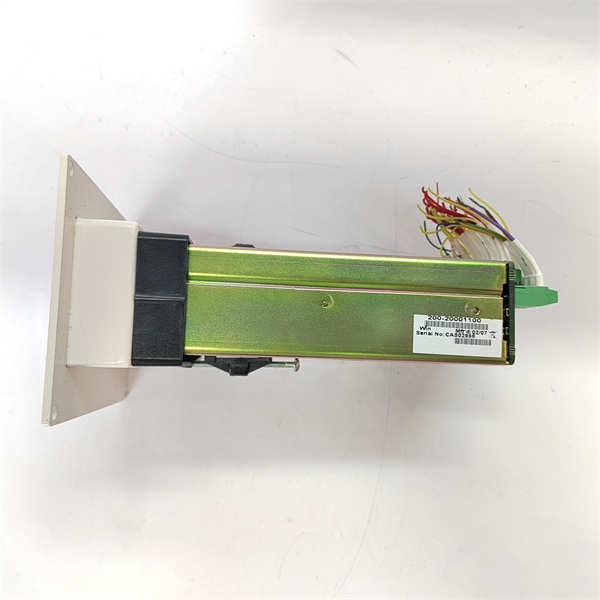
| Dimensions | 45 × 123 × 129 mm (1.77″ × 4.84″ × 5.08″) |
| Certifications | CE, UL 508, RoHS |
Product Introduction
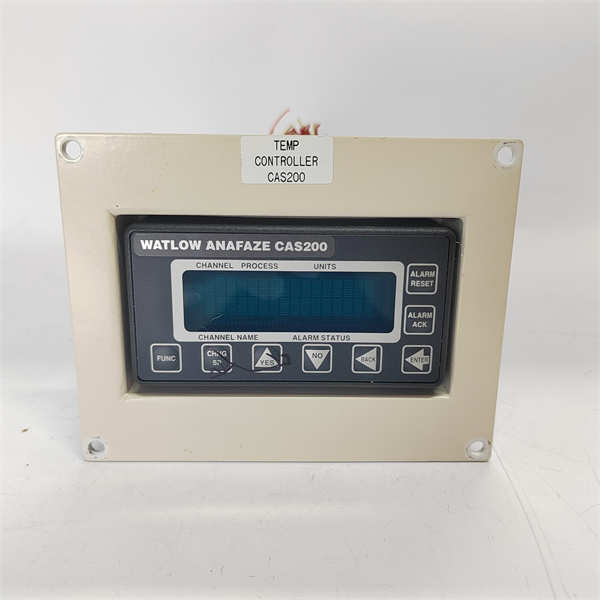
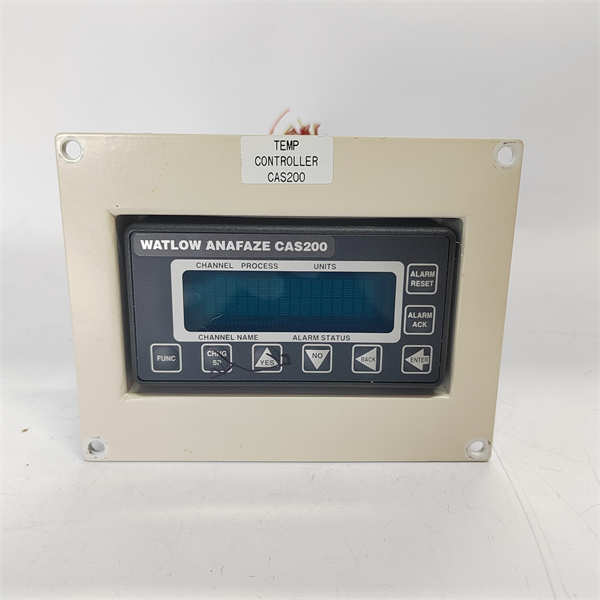
The Watlow CAS200 represents a next-generation compact control platform integrating precision temperature regulation with advanced automation capabilities. Designed for demanding thermal processes, this DIN-rail mountable unit combines a high-resolution controller, power switching components, and communication interfaces in a single ruggedized package. Unlike conventional controllers, the CAS200 implements dual PID loops with independent setpoints, enabling cascade control strategies for complex applications like multi-zone furnaces or injection molding.
Engineered with industrial IoT readiness, the Watlow CAS200 features native support for major industrial networks including Modbus RTU, CANopen, and DeviceNet, with Ethernet/IP available in the R9 series. Its modular I/O architecture accepts plug-in terminal blocks for flexible sensor input and power output configurations. The controller’s 1/16 DIN footprint belies its computational power – 32-bit processing enables adaptive tuning, ramp/soak programming, and real-time diagnostics. For thermal management professionals, the CAS200 delivers unprecedented integration density, replacing traditional controller-relay-communication stacks with a unified solution that reduces panel space by up to 75% while enhancing system diagnostics.
WATLOW CAS200
Core Advantages and Technical Highlights
Multi-protocol industrial connectivity: The Watlow CAS200 eliminates communication gateways with native DeviceNet, CANopen, and Modbus RTU ports. This enables direct PLC integration and real-time data access for SCADA systems without additional hardware.
Advanced thermal algorithms: Dual PID loops with autotune capabilities dynamically optimize heating/cooling responses. The proprietary Dynamic Setpoint feature anticipates thermal inertia during ramp phases, achieving ±0.5°C stability even during rapid temperature transitions.
Modular field wiring: Hot-swappable terminal blocks (Cage Clamp®) allow input/output reconfiguration without power-down. Users can mix RTD inputs, relay outputs, and analog signals in any slot – a critical advantage for retrofit upgrades.
Robust power management: Integrated zero-cross SSRs and snubber circuits enable 100,000+ cycle relay life at full 5A load. Optional Load Sense technology detects heater failure by monitoring current draw, triggering predictive maintenance alerts.
Engineering efficiency: Built-in web server (Ethernet models) permits configuration via any browser. The Auto-Detect feature recognizes connected sensors and automatically applies calibration parameters. UL 508 listing simplifies panel certification.
Typical Application Scenarios
Plastic processing: In injection molding machines, the Watlow CAS200 independently controls barrel zones and mold temperature circuits. Its dual PID loops manage heater bands while coordinating water valve modulation for cooling phases, achieving ±1°C stability during material transition points.
Semiconductor manufacturing: For diffusion furnaces, the controller’s fast 100ms sampling enables precise ramp control (0.1°C/sec) across multiple heating zones. CANopen integration synchronizes temperature profiles with robotic handlers.
Packaging machinery: Sealing jaws utilize the CAS200‘s relay outputs for pulsed heating, with RTD inputs providing closed-loop control. The Load Sense feature detects broken cartridge heaters before production defects occur.
Laboratory equipment: Stability-critical applications like environmental chambers leverage the controller’s ±0.1% accuracy and 50-program recipe storage. RS-485 connectivity allows centralized monitoring of distributed instruments.
Related Model Recommendations
CAS200-R9: Adds Ethernet/IP and embedded webserver
CAS202: Single-loop economic variant
F4T: Touchscreen controller with datalogging
PM3R3AAB-E000: Power module for 3-phase loads
EZ-ZONE RM: Multi-zone temperature control system
PXR3: Micro-processor-based temperature controller
ANAB1M1: Analog input expansion module
DIN-AG-C2: DIN rail power supply companion
WATLOW CAS200
Installation, Commissioning and Maintenance Instructions
Installation preparation: Verify voltage compatibility (jumper-selectable 24VDC/VAC). Ensure minimum 30mm clearance above/below the Watlow CAS200 for heat dissipation. Use 14-22 AWG shielded cable for analog signals, grounded at controller end only. Pre-configure communication parameters offline using Watlow’s CAS Setup software.
Commissioning procedure: After DIN-rail mounting, initialize with Auto-Tune during process stabilization. Configure fail-safe modes (e.g., fallback setpoint on comms loss). Validate sensor readings against calibrated reference at three points (low/mid/high range). Enable Soft Start to prevent inrush current during cold startups.
Maintenance suggestions: Quarterly calibration verification using process simulator. Annually clean ventilation slots with low-pressure air. Monitor relay cycle counts via Modbus register 40125 – replace at 80% of rated cycles (typically >100k). For firmware updates, use BootP utility over Ethernet. Maintain configuration backups on SD card (R9 models).