
 Email: sales@slxytech.com
 WhatsApp / Wechat:8617062388866
 Phone:+86 17062388866
Description
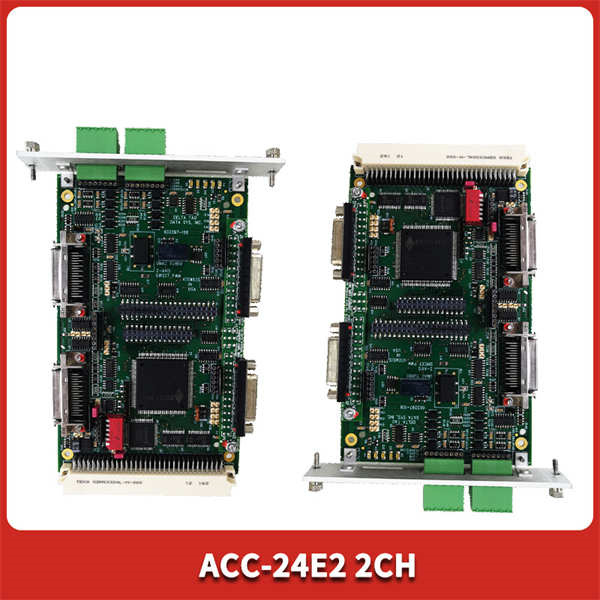
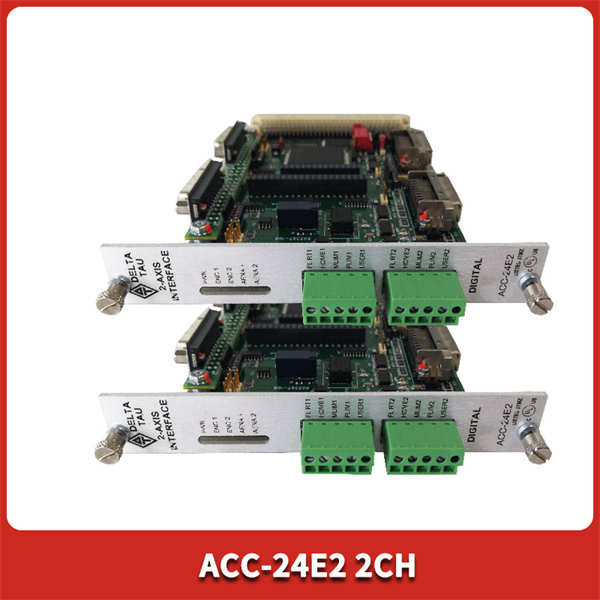
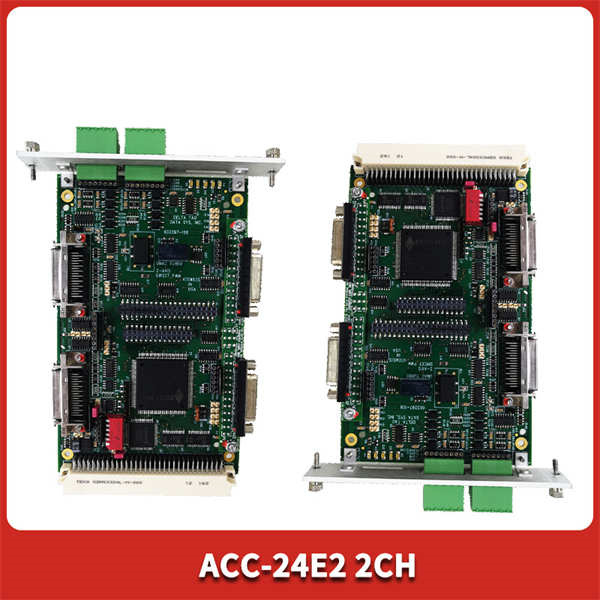
The DELTA TAU ACC-24E2-2CH is a high-performance motion control interface module designed for precision multi-axis servo systems in advanced automation applications. Part of Delta Tau’s renowned UMAC (Universal Motion and Automation Controller) platform, this dual-channel module provides deterministic EtherCAT connectivity and ultra-low jitter for synchronized motion in robotics, CNC machinery, and semiconductor manufacturing. The ACC-24E2-2CH integrates two independent channels, each supporting up to 8 axes of servo control with 24-bit encoder feedback resolution. Its core function bridges Delta Tau’s Turbo PMAC2 CPU with EtherCAT drives and I/O networks, enabling nanosecond-level synchronization for complex contouring and gantry systems.
Engineered for demanding environments, the DELTA TAU ACC-24E2-2CH features galvanic isolation (1,500 Vrms) on all I/O interfaces to prevent ground loop interference. The module supports SERCOS, Step/Direction, and ±10V analog command interfaces alongside direct encoder inputs (A/B/Z, SSI, BiSS-C). With real-time EtherCAT master capability and <100>ACC-24E2-2CH delivers industry-leading precision for applications like wafer steppers, laser cutting, and additive manufacturing where sub-micron accuracy is critical.
DELTA TAU ACC-24E2-2CH
Technical Specifications
| Parameter Name | Parameter Value |
| Product Model | ACC-24E2-2CH |
| Manufacturer | Delta Tau Data Systems |
| Product Type | Multi-axis Motion Control Interface |
| Control Channels | 2 (independent, 8 axes each) |
| Encoder Inputs | 24-bit resolution (differential RS422) |
| Feedback Types | Incremental/absolute (SSI, BiSS-C, EnDat 2.2) |
| Command Outputs | ±10V analog, PWM, Step/Direction, SERCOS |
| EtherCAT Ports | 2 (100BASE-TX, daisy-chainable) |
| Servo Update Rate | 50 µs (minimum) |
| Jitter | < 0> |
| Isolation | 1,500 Vrms (channel-to-bus) |
| Power Supply | 24 VDC ±10% (2.5A max) |
| Operating Temperature | 0°C to +55°C (32°F to 131°F) |
| Certifications | CE, RoHS, UL 61010-1 |
| Dimensions | 200 mm × 100 mm × 40 mm (W×H×D) |
Main Features and Advantages
Deterministic EtherCAT performance: The ACC-24E2-2CH achieves sub-100 ns synchronization jitter across axes using dedicated FPGA timing control. This enables precision phase-locked motion in multi-spindle systems—critical for gear machining and electronic component placement.
Flexible I/O architecture: Each channel accepts mixed feedback types (e.g., SSI absolute encoders + resolver inputs) simultaneously. Integrated SERCOS III optical ports allow legacy drive integration without additional gateways.
Advanced diagnostics: Real-time monitoring of following error, drive fault status, and encoder health via Delta Tau’s PEWIN software. Automatic cable fault detection (open/short) minimizes commissioning time.
Vibration suppression: Patented adaptive filtering algorithms in firmware dampen mechanical resonances during high-acceleration moves. The DELTA TAU ACC-24E2-2CH dynamically adjusts servo gains based on load inertia changes—ideal for robotic material handling.
Scalable topology: Daisy-chaining via EtherCAT reduces cabling by 70% compared to star architectures. Hot-swap capability (with PMAC3 CPU) allows module replacement without rebooting controllers.
Application Field
The DELTA TAU ACC-24E2-2CH excels in ultra-precision motion systems:
Semiconductor: Coordinates wafer stages in photolithography steppers with <5>
Medical Devices: Synchronizes multi-axis robotic arms in MRI-guided biopsy systems requiring EMI immunity.
Aerospace: Machines turbine blades using 5-axis CNC with real-time toolpath compensation.
Printing/Converting: Controls rotary die-cutters with electronic gearing for web tension management.
Additive Manufacturing: Drives galvo scanners in metal 3D printers with nanosecond laser timing.
Test/Measurement: Performs dynamic fatigue testing with synchronized hydraulic actuation.
Related Products
DELTA TAU UMAC CPU Turbo PMAC3: Main processor for ACC-24E2-2CH integration.
DELTA TAU ACC-65E: Breakout board for simplified ACC-24E2-2CH wiring.
DELTA TAU I/O720: Digital I/O expansion module.
DELTA TAU ACC-59E3: Analog input module (complements motion control).
DELTA TAU ETH-400: Ethernet switch for ring topology redundancy.
DELTA TAU PS3000: 24VDC power supply (optimized for UMAC racks).
DELTA TAU ACS SPiiPlus SC: Drive system compatible with ACC-24E2-2CH commands.
DELTA TAU ACC-24E2-2CH
Installation and Maintenance
Pre-installation preparation: Verify UMAC rack compatibility (requires Slot 2/3). Install Delta Tau PEWIN software for configuration. Use shielded twisted-pair cables for encoder signals with drain wires grounded at one end. For the ACC-24E2-2CH, allocate 25 mm lateral clearance for heat dissipation.
Maintenance recommendations: Monitor FPGA temperature via PEWIN diagnostics. Re-calibrate analog outputs annually using precision voltmeter. During module replacement, discharge static electricity before handling. Update firmware via Ethernet using Delta Tau’s Firmware Manager. Clean air vents quarterly in particulate-heavy environments.